
Oak Forest Directory Collections
The Oak Forest city directory shelf is regional. South Suburban Genealogical and Historical Society, or SSGHS, holds the strongest located run, while Newberry Library provides digitized examples and a 1923 R.L. Polk place index that names Oak Forest. Acorn Public Library supplies the local handoff to databases and research help.
| Directory collection | Years found | Repository | Access route |
|---|---|---|---|
| Chicago city directories | 1871-1917, 1923, 1928-1929 | SSGHS | Ask for the exact volume and copying policy |
| Regional digitized examples | 1892, 1900, 1923 | Newberry Library | Free scans located online |
| Regional telephone directories | Years not stated; June 1977 catalog lead | SSGHS and Library of Congress catalog | Confirm coverage before visiting |
| Genealogy databases and referrals | Collection-specific | Acorn Public Library | Website, staff help, and in-library Ancestry |
Do not turn those ranges into a claim that Oak Forest appears in every volume. The city may be represented through a regional place index, nearby community coverage, a telephone exchange, or no entry at all. No last printed Oak Forest-specific directory year was located. Missing years between the known SSGHS holdings must remain gaps.
South Suburban Directory Shelf
SSGHS expands a directory search beyond names and addresses. Its holdings include county atlases, family histories, high-school yearbooks, church histories and records, regional phone books, cemetery indexes, funeral records, and Acme Steel newsletters from 1926-1932, 1935-1950, and 1954-1961. These sources can explain an abbreviation, connect a relative to a school or church, or supply a date between printed volumes.
Access may require an appointment, member research fee, or reproduction charge. Contact the society with the person's name, spelling variants, street, approximate year, and the precise volume or record set wanted. Ask whether a volunteer can inspect both the alphabetical and street sections.
Inspect the SSGHS holdings overview before making the request.
Oak Forest in the 1923 Index
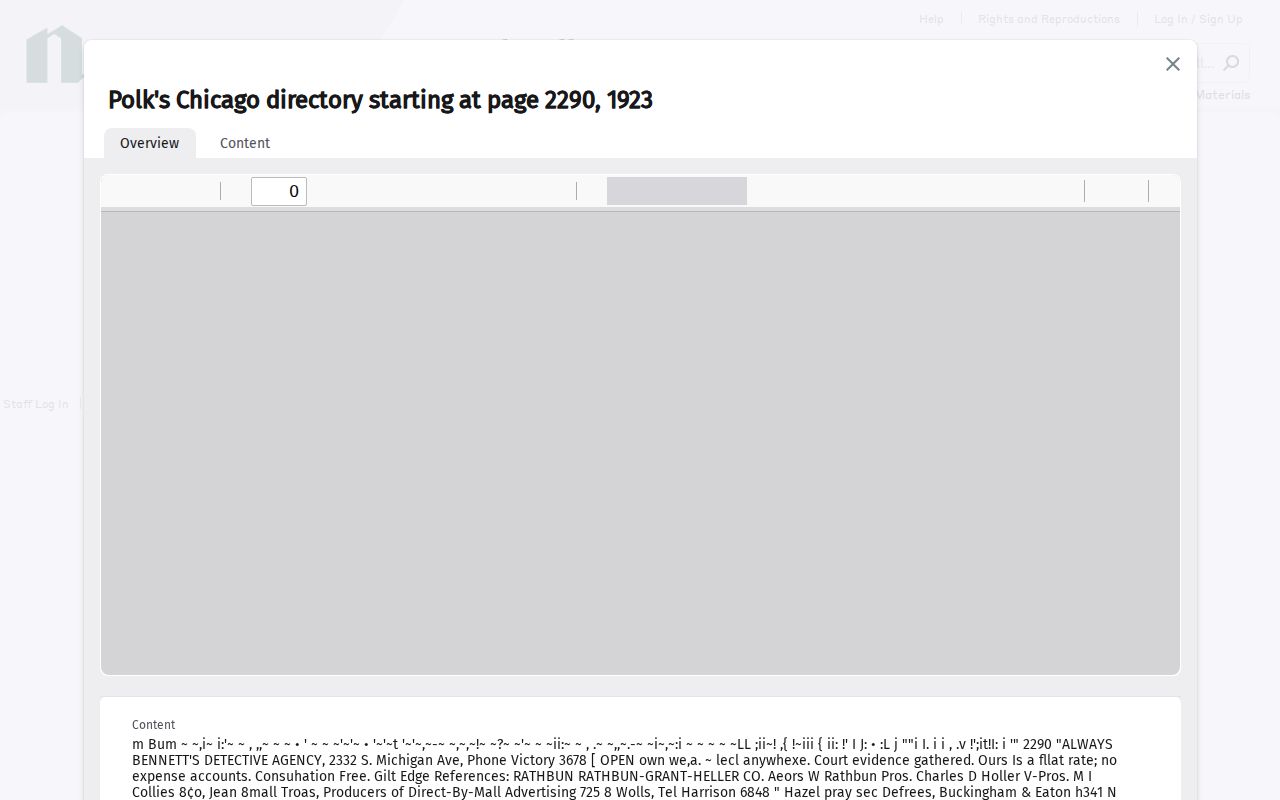
A digitized 1923 R.L. Polk directory place and distance index at Newberry includes Oak Forest. That is a strong location anchor, but it is not proof of a self-contained local volume. Follow the place reference into the book, check the title and publisher page, and record how the index directs readers to the relevant entries.
Newberry also supplies regional directory examples from 1892 and 1900. Search the scan for Oak Forest, Bremen, a surname, and street variants. Optical character recognition can miss faint print or abbreviations, so browse nearby pages when the text search fails.
View the Newberry digitized directory entry used for the collection trail.
Read an Oak Forest Directory Entry
City directories compress a household into one or two lines. Read the abbreviation key before interpreting the entry. A name may be followed by a spouse in parentheses, work or business text, and a residence. Marks such as h for home and r for room describe the entry's context, but conventions can change by publisher and year.
| Listed name | Usually the indexed adult; search initials, full names, and spelling variants. |
|---|---|
| Spouse or household mark | A parenthetical name or status may distinguish same-name entries. |
| Work or business | Occupation, employer, or business role may identify the right person. |
| Address | House number and street at the directory's snapshot date. |
| Residence mark | Publisher symbols such as h or r need the volume's own key. |
- Criss-cross directory
- A street-order listing that lets a researcher start with an address rather than a surname.
- Householder index
- A section organized around the listed head or principal adult of a household.
- Abbreviation key
- The volume's legend for short forms, residence marks, occupations, and other symbols.
Photograph or save the title page, date, abbreviation key, entry page, and street page. Without that context, the same letter can be misread across publishers.
Oak Forest Genealogy at Acorn
Acorn Public Library is the practical local bridge from a web result to deeper research. The library stands at 15624 S Central Avenue and can be reached at 708-687-3700 or acorn@acornlibrary.org. Its hours are Monday through Thursday 9:00 a.m. to 9:00 p.m. and Friday and Saturday 9:00 a.m. to 5:00 p.m.; Sunday is closed.
Ancestry Library Edition is available only inside the library. The genealogy page also points to Cook County vital and genealogy records, Circuit Court Archives, Illinois State Archives, National Archives, Newberry tools, SSGHS, FamilySearch, and other research routes. A Genealogy Drop-In meets on the first Wednesday. Ask staff whether unlisted directories, local newspaper microfilm, obituary files, plat books, or a house-history referral are available before assuming the online page is complete.
Review Acorn's local community resources before a visit.
Oak Forest Names Across Time
A historical search needs more than the present city name. The area was known as Cooper's Grove after settlement in the 1830s. Its post office became New Bremen in 1848. The earliest located use of “Oak Forest” is in an 1893 Chicago Rock Island & Pacific Railway timetable. The community incorporated as a village in 1947, became a city in 1971, and adopted home rule in 1981.
Search Cooper's Grove, New Bremen, Bremen Township, and Oak Forest in maps, directories, church records, cemetery files, and census indexes. The name shift may explain a blank result better than a claim that the family left.
Oak Forest Directory Companion Records
Two SSGHS collections provide strong endpoints for local family research. The Blue Island Sun obituary index covers 1919 through 1969. Oak Forest Hospital Cemetery records cover 1910 through 1971. FamilySearch also catalogs an Ebenezer Evangelical Lutheran Cemetery transcription with burials from 1921 through 1963 and a map.
Pair a directory name and address with an obituary date, cemetery entry, Cook County genealogy request, probate file, or funeral record only when the details match. An institutional cemetery record deserves care. It may identify a person and date without explaining why the person was there or where surviving family lived.
Trace Oak Forest Families by Directory
A directory sequence can fill the years between public census schedules. It works only when every volume is treated as a snapshot. A disappearance may mean a move, death, omission, name change, or a gap in coverage. It does not prove which occurred.
- Find the earliest likely surname entry. Copy the spelling, spouse or household mark, work text, address, volume, year, and page.
- Check the same surname in a nearby volume. Record an absence as “not found in this volume,” not “not resident.”
- When a street section exists, search the house number and nearby entries. Confirm that the alphabetical and street entries agree.
- Pair directory years with the public federal census schedules for 1870 through 1950 as applicable. Census schedules follow a 72-year release rule.
- Test owner history through Cook County deeds and parcel records, then use obituaries, cemetery files, or probate for a supported endpoint.
Owner and occupant are separate roles. A deed may name a person who never appears in the city directories, while a listed occupant may be a relative, boarder, caretaker, or business contact. Keep the directory sequence, deed chain, and parcel timeline as three columns rather than forcing them into one account.
Reach Oak Forest Directory Sources
Begin online with Acorn's genealogy links, Newberry scans, SSGHS holdings, FamilySearch, and the Illinois archival repository and IRAD searches. When a scan or catalog record stops short, contact the holding library or society by phone, email, or mail. Give the exact volume, approximate year, surname, address, and page if known.
In person, use Acorn's Genealogy Drop-In, SSGHS research access, or the relevant reading room. Ask about accounts, appointments, copying rules, member research charges, and whether staff can check a street section. Illinois State Archives catalogs official government records and is not a complete newspaper or manuscript index, so church registers, naturalization files, military records, yearbooks, and local papers may require a different repository.
Write down negative searches with the collection title and year. Oak Forest may appear only in a place index, a Chicago-area volume, or a regional telephone book, and the surname list may use initials instead of a full given name. Check the abbreviation key before deciding what an occupation, spouse mark, home mark, or room mark means. When a page is hard to read, compare the alphabetical entry with the street section and the prior or next edition. That method catches print damage and indexing mistakes without turning an uncertain letter into a fact.
For a copy request, provide the exact citation: repository, directory title, publisher when known, year, page, column, and entry. Ask whether the scan includes front matter and the place index. Those pages define the coverage and abbreviations that make an entry understandable. If no Oak Forest-only run exists, say that clearly and cite the regional volume actually searched.
Coverage check. A catalog title for Chicago or Cook County does not guarantee an Oak Forest entry; confirm the volume, place index, and page.